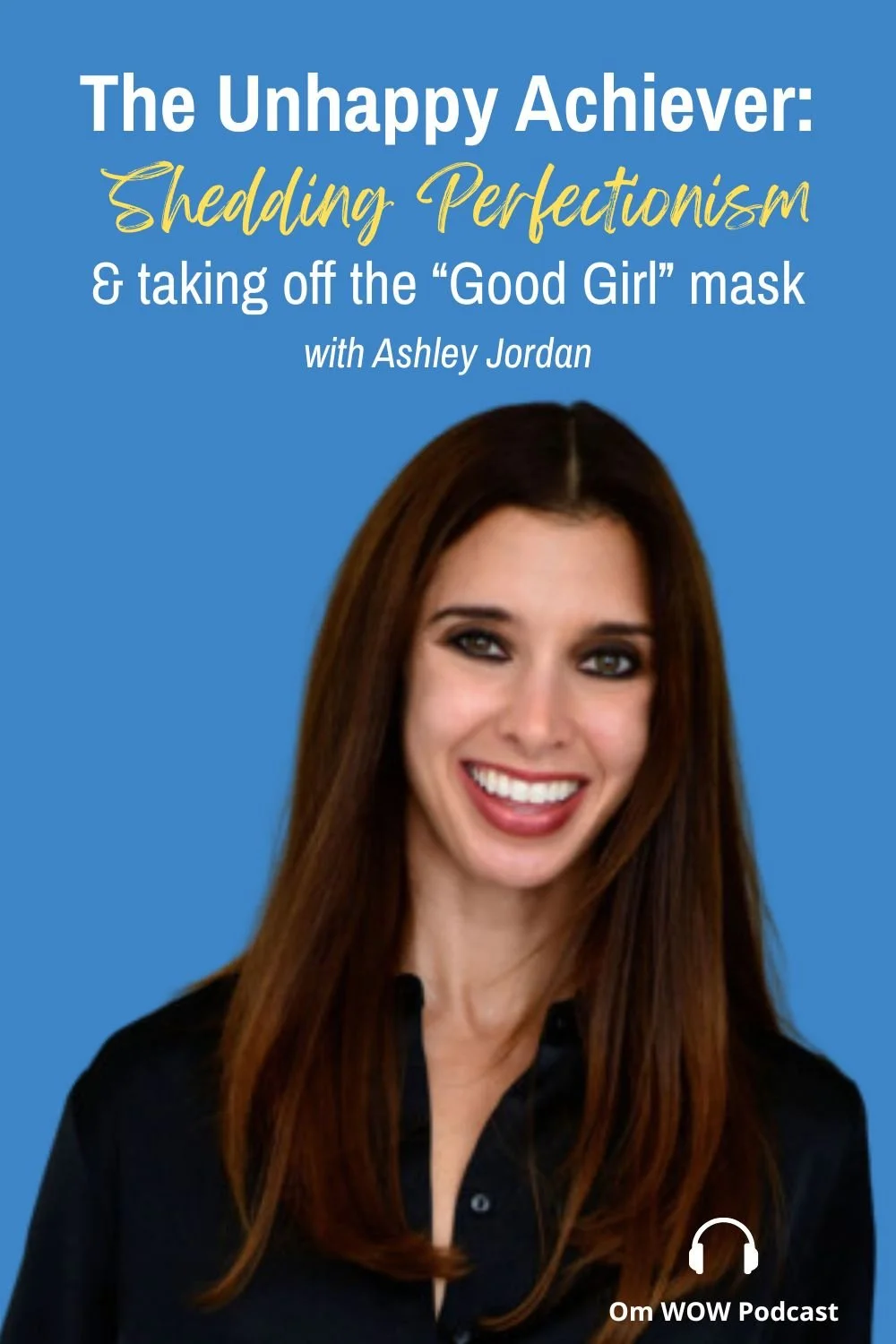
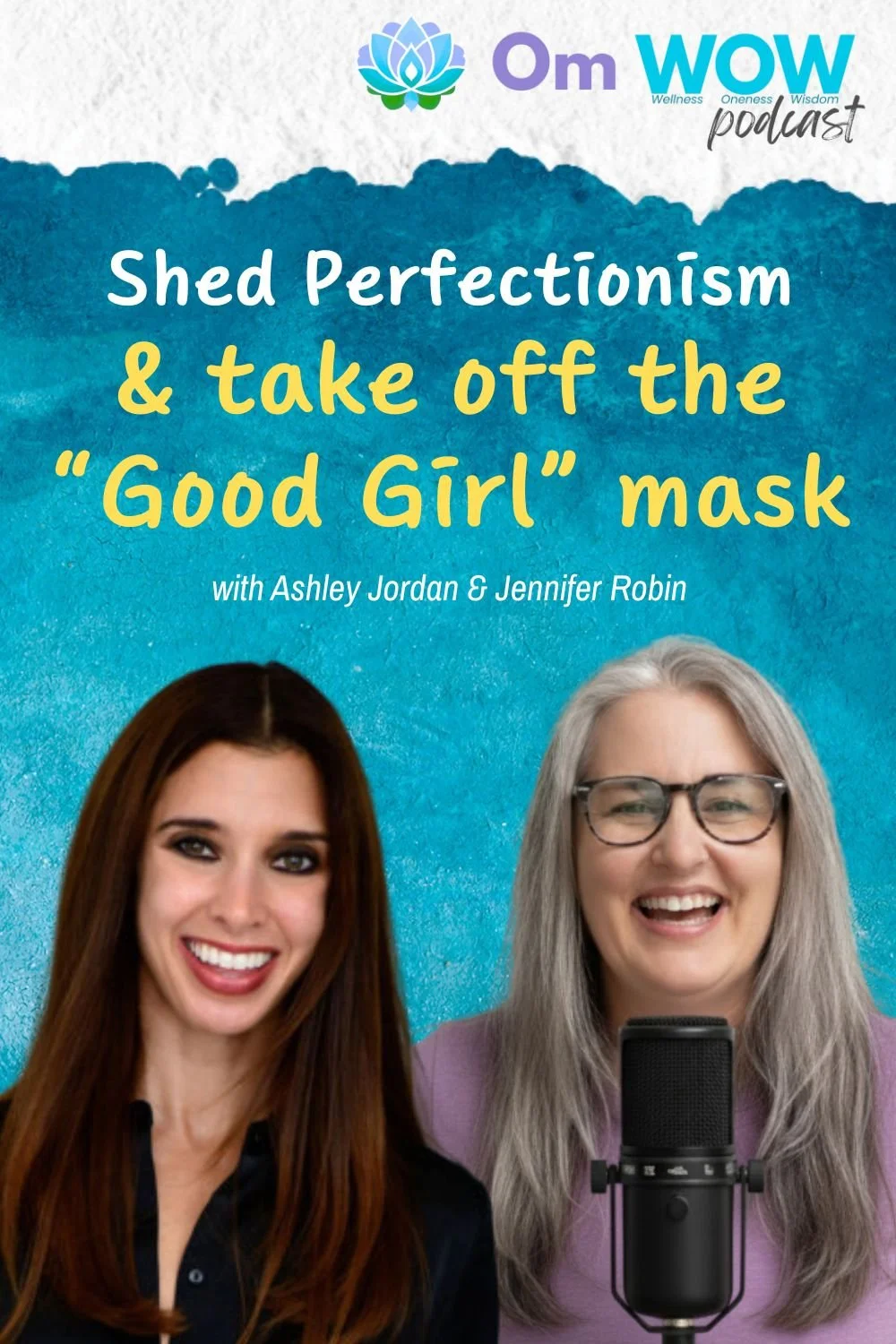
The Unhappy Achiever: Shedding Perfectionism & Taking Off the Good Girl Mask with Ashley Jordan
Episode #39: Show Notes
Have you ever achieved everything you thought you wanted, only to feel empty inside? That's exactly what happened to my guest, Ashley Jordan, author of Unhappy Achiever: Rejecting the Good Girl Image and Reclaiming the Joy of Inner Fulfillment.
Ashley is a nationally recognized journalist, speaker, and author whose bylines have appeared in The New York Times, the Washington Post, the Guardian, and HuffPost. In this powerful conversation, she shares her journey from picture-perfect life to authentic fulfillment, and why the process of "unbecoming" changed everything.
📖 Transcript for this episode (PDF)

Listen to the full episode:
Watch this episode’s video:
What Does Unbecoming Really Mean?
When I asked Ashley to tell us about her journey of unbecoming, she offered a perspective that completely flips the traditional self-improvement narrative.
"You often hear the word becoming used, but what I really discovered in my own journey is that it's not really about becoming, it's about unbecoming," Ashley explained. "When I say unbecoming, what I mean is it's not about becoming someone else, because I think that that often tends to have a connotation of 'I'm not good enough as I am, and so at a certain point in the future, I will be better.' And I think that that's really a trap, actually, when it comes to self-love and being who we were born to be."
Ashley believes we were born as everything we needed to be, and all we're really doing is peeling back the trauma, the conditioning, everything that's been piled on to obscure our unique, beautiful essence.
"It's not about becoming something, it's just about stripping away all of the stuff that obscures who we already are underneath."
She describes this as returning to the divine being that we came in as—our perfect self.
The Inspiration Behind Unhappy Achiever
Ashley's path to writing her book wasn't straightforward. She had been freelance writing for newspapers and magazines when she stumbled into her journey of unbecoming about five years ago.
"I wish I could tell you that one day I woke up and I realized that I really didn't know myself and that I had this picture-perfect life that was externally perfect but inwardly broken, and that I needed to do something about that. That is not the way it happened, really. I stumbled into it. I cracked open."
At 37 years old, Ashley had done all the things she was taught good girls should do. She believed that if she did them, she would be happy and fulfilled. Externally, her life was shiny and beautiful. She had done all the things. She had all the things.
But here's what she discovered: "I was empty inside and emotionally I was numb, and I actually had no idea who I was underneath the life that I had built."
Writing the Book She Needed
Ashley realized she had a story to tell about what it looks like when you've built the unhappy achiever life—when you were the good girl who learned to earn love by being perfect, meeting expectations, seeking approval and achievements, being shiny and pretty. And what it looks like when you get to the place where the fairytale was promised and you feel nothing.
"I wanted to write a book that would be every person's, every woman's literary best friend on a journey like mine. Because when you are dismantling a life that you built from the outside in to rebuild one from the inside out, it is lonely. It is messy. And so I wanted the book that I wish I would've had in that space."
She wanted women to open the book and think, "Oh my gosh, if she can do it, I can do it too. If she went through this, that means there's nothing wrong with me. I'm not crazy for wanting more than this."
The Breaking Point
There's a chapter in Ashley's book called "Selah," a word she fell in love with during her journey with grief. It was repressed traumatic grief from childhood that unexpectedly cracked open and set her on this path.
"That is in that space of grief where emotional trauma sort of erupted and knocked me down on the ground overnight. And so I had gone from unhappy achiever. I say in the book, you know, borrowing from Hamilton, I was writing and living like I was running out of time. And I went from racing around and running through my life from one thing to the next to the next, to literally on the ground almost overnight."
Finding Yourself in the Silence
In that space of cracking open emotionally, where her body was riddled with so much emotional pain that the best she could do was just breathe and be in that space of quiet—that's where she started to rediscover herself for the first time.
"When we think about unbecoming, it is that space of silence. It is in the silence and in our own undoing that we actually find ourselves again for the first time. That is what unbecoming to me looks like in its purest form. It is surrender. It is the release of manic doing and every day racing around, to stop, to start to find stillness. Enough stillness to start to hear our inner wisdom and our hearts again. And that is messy."
Ashley shared something that really struck me. She was the girl who never cried. Starting at age six, she remembers breaking her elbow and not shedding a tear. She had already learned that strength meant showing no emotion at all.
"The reward for that was that at 37, I got to cry every tear I never cried. And I don't recommend that, but sometimes that's what we have to do."
When Friendships Fall Away
One of the most painful parts of Ashley's unbecoming was what happened with her friendships. The more she reconnected with herself, the more she went from seeing the world in black and white to Technicolor.
"Suddenly I started to look around and there was magic that I could see and feel that I had never seen or felt. And not so much that I didn't know it, but that I had forgotten it."
The Painful Reality of Growth
The more she became herself authentically, the more excited she became. "I think this happens to a lot of us on these journeys. We kind of start to reawaken to ourselves and we're thinking, 'This is amazing. I want to tell everybody I know. I'm Ashley Jordan 2.0. My friends are going to love me. I can be a better friend, I can be a better mother. I'm just a better me.'"
But not everybody loved that new version of her. In fact, Ashley had friends who she considered dear, close friends who were saying, "Who are you?" They wanted the old Ashley. That was the version they knew, the version they had co-resonance with.
Understanding Co-Resonance
Ashley explained it this way: "I had to learn, even though those friendships falling away were deeply painful for me—almost even traumatic in its own way—I was heartbroken. I couldn't understand it. I really struggled. But now I've realized that it doesn't make them good or bad, right or wrong, or me good or bad, right or wrong. It's just that we had a co-resonance when we came together in relationship, and when I changed, I was on a different rate. It's we were both on the same radio station and then I was on a different one."
In order to meet in the same radio station, somebody had to go up and somebody had to come down, and it was very uncomfortable for everyone involved.
"It's so helpful to realize it's not a rejection of you. It's that they don't know that version of you. And there just isn't co-resonance. It doesn't mean even that there will never be; it just means at this point you're at different places in your own journey."

New Relationships Emerge
Unbecoming can be really messy and hurtful, and when those relationships fall away, it's really hard. But within a year, new relationships came. Ashley attracted new people who resonated with the real her.
"Oh my gosh, the sisterhood that I have now is unlike any I ever knew before. I did not know the love that can exist between women, the soul-level love that is just as powerful in its essence as any romantic love would ever be. It's just a different expression of love. But it is just as true, unconditional, heartfelt, soul-nourishing, and I'll say one of the most liberating forms of love that we can now truly experience."
The Challenge of Changing Expectations
As Ashley moved from constant doing to more being, something else shifted. People have their own expectations for what we're going to be and do. When you adjust your life for the better to benefit you, sometimes the ripple effect on the people around you creates tension because they were expecting something else.
The Problem With Only Giving
Ashley shared that early in her journey, a very intuitive friend said to her, "You have a hard time accepting love. You struggle to receive it even now." When she shared this insight with another friend, the friend looked at her befuddled and said, "Really? Because I don't think you have a problem with love at all. You just give and give and give love."
But that was exactly the point. Ashley wanted to see what it would be like to receive it too.
"When I sort of entered that place, I wasn't fulfilling that role for people anymore. I wasn't just giving and giving and giving, performing and performing and performing. I wanted balanced relationships, reciprocal relationships that flow like water wheels, ebbing and flowing in natural rhythms, and not just one person pouring out constantly."
Why We Find It Easier to Give Than Receive
Getting really honest with herself, Ashley realized it was much more comfortable for her to give for a couple of reasons. One, she could control that. She could control what she gives. With the help of a therapist, she identified this: she had learned to use being good, giving, being pleasing to protect herself. You will love me if I show up this way.
This is such a common thing, especially for women. It's such a part of our conditioning.
"True embodied self-love requires learning to receive love and to say, 'I don't have to perform. I give when I authentically feel inspired to and it's from my heart, but I also value receiving and being in relationship with those who also give and receive. And so we can have these reciprocal, balanced relationships where we're both nourished."
Reclaiming Your Power
When I mentioned "energy vampires," Ashley had an interesting perspective. She shudders at the term because there's this feeling of someone's taking advantage of me, I'm being victimized. But we're doing it by choice.
"We get something out of it too. And so it's I co-create that with someone. And the great thing about that is I'm not a victim. I can change it. I can decide for myself that I don't want to do that anymore."
This is so helpful to remember because when we hear people talk about being an empath and things of that nature, that's a beautiful thing to know about ourselves. But we can also take our power back where we have given it away.
"We can reclaim. I love the word reclaiming in these journeys. We can reclaim what we've lost by adopting new ways of being in relationship with ourselves and others."
How to Start Being in Relationship with Yourself
When Ashley gets this question, especially from women who are saying, "I've totally lost myself. How do I even go about finding her again?" she always gives the same answer, because when she started this, she was walking the wilderness on her own, trying to figure it out. She did not know what was happening to her.
"All you need is start taking some time to yourself. Five minutes a day. If you can start finding five minutes a day to just sit in silence, meditate, walk in nature, read a book you love, do something that you love. Because for most of us, we lose that connection with ourselves when we stop carving out time to remember ourselves, to be us in the most authentic expressions."
The Eight-Year-Old Question
She always comes back to this question: What did you love to do when you were eight years old?
"Think about what you loved to do when you were eight years old, because when you were eight years old, you did what you did with abandon. You didn't have a boss on your back or you weren't so bogged down by other people's expectations and approval. You just did what you did for the sake of joy. And so what did you love to do? Because often there are clues about not only what brings you joy, but also about what you were born to do."
Return to some of those things. If that was drawing, start drawing again. If that was dancing, start dancing again. Find some time for you again, even if it's only five minutes a day, and start there.
Dancing Like Nobody's Watching
Ashley thinks that the truest pieces of art that come from us are written if we're doing it from a place of dancing like nobody's watching—when we're really not thinking about who's going to receive it. We're just thinking about speaking from the soul, from the heart, from the deepest, purest place inside of us. And that is how she wrote this book.
The concept of writing a book had come up a few times before she started writing Unhappy Achiever. But inside the thought of that was, "I could do that now, but I'm not feeling it's time." Even some potential ideas for books came from articles she had written. And they weren't bad ideas. One of them in particular was even a book that probably needs to be written. But she wasn't feeling it.
When the title Unhappy Achiever came, it was, "Oh my God, that's it." When people hear it, they're thinking, "Me too." For Ashley it was the lens through which she could view almost her entire life story, and she knew so many people could relate.
Following Inner Knowing
Then when it was time to start writing the book, it felt—and this is the way Ashley thinks that intuition and inner knowing work—it just felt like an internal breath. "Oh, it's time to write this book. It's time. This is what I'm going to do." And then she just started. It wasn't that she had to think about this for weeks and months and analyze. It was, "I just know this is the book I'm meant to write, and now it's time to start writing it." And so she did.
Writing a book, you know, it's funny to ever describe it as an easy process. It's a labor of love. But if Ashley were to describe this in feminine terms, the feminine side was she intuitively knew it's time to do this. And then it flowed through. It flowed through her. It flowed from her. She never knew the chapter she was writing next until she finished a chapter, but then the next one came always. There was no delay. There was no writer's block.
I had to stop and acknowledge that for a moment because I've never heard that from a writer ever.
The Flow State
It is the absolute truth, Ashley assured me. And there was a time where in her own journey she was going through something and she needed to take about a month off from writing emotionally. But as soon as she was ready to step back in, she just stepped right back in and it started again.
Even the path to publication was magical. The right team at the right time, everything fell into place. So it was just one step after another in perfect timing. She got to write the book she wanted to write from start to finish with the team she wanted to work with to an eerie degree, just a magical degree.
Manifestation in Action
Ashley literally held a book in her hands two months before she signed with her publisher, thinking, "I want my book to feel like this one. I love even the way the pages of this book feel." And two months later she was in a meeting with the publisher combined with the editorial director of that publisher. And literally the director started talking about the books she worked on and she turned around and said, "Have you read this one?" And it was the book that Ashley held in her hand two months earlier.
So Ashley worked with the team that published that book, that worked on that book. She had the same editorial and marketing team for her book.
"It's magical when we are working from our inner wisdom and our inner knowing. It doesn't always necessarily look exactly the way that we think it will, but it's we are guided. Every step of the journey kind of falls into place for us in ways we could never even imagine. And so from that perspective, it was so easy and magical."
The Balance of Masculine and Feminine
Now, from the masculine perspective, she also had to show up and write and write a book proposal and take all of the steps, the hard work that has to happen to create a book and birth it into existence.
The advice that Ashley would give to anybody thinking of undertaking a project is: "Whatever your time of day is, these are the times I show up to do this. I show up to write this book." And she released the expectation. Some days when she showed up and set her alarm—for her it was 6 to 7 a.m. a lot of the time, and then maybe two more blocks of time in the day, one-hour blocks—she silenced everything else and showed up at these times and let what's meant to come, come. And if nothing comes, okay, fine, she showed up.
Something always came, by the way. But sometimes it was a paragraph or two. Sometimes it was a page or two. It varied. But so many books have been written in one hour a day.
"What I always say is it's about also committing to yourself and your creation and showing up for it consistently. And so that's the balance I think that we have to find to create from the deepest places and parts of ourselves."
How to Reconnect with Your Intuition
Ashley's intuition sounds incredibly developed, but she wasn't always clued in to listening to her inner self. Literally. She writes about this in the book too.
Ashley remembers sitting with her therapist at the time and saying, "I don't know what's happening to me. Am I losing my mind? Am I going crazy? I don't know what is happening right now." And the therapist said, "Well, what does your heart say? You know the truth, Ashley. You have the power to know things."
Ashley just looked at her completely puzzled. "What are you talking about?"
The therapist asked, "What does your heart say?"
And Ashley responded, "My heart? That is an organ that pumps blood throughout my body, but it doesn't tell me anything. That is something people say. I live here." She was pointing to her head. "I live here and I operate from that place. And then I ask people, everyone outside of me what they think, and then I weigh my options."
Breaking Free From External Authority
We all do that, right? We want everyone else's opinion, their blessing. Yes, you're on the right track.
"Which is so funny to me because I always say that's the thing about these journeys: there is no outside expert. Only you, you alone, are the soul best expert in your own path, in your own journey. And it's hilarious that we look outside of ourselves asking, 'Who else can tell me what to do with my life better than I'm going to decide?'"
But that's how we were raised. From little kids we learned to trust the authorities and do what they say, your teacher and your parents and so on.
Ashley pointed out that this really serves a system very well. And if you don't trust yourself to be the ultimate authority in your own life and your own path, you will give all your power away to other people. And that serves everybody else much better than it will ultimately serve you.
The Path Back to Inner Wisdom
So how do you reclaim that power? How do you reconnect with your inner wisdom, with your own heart?
Ashley truly was asking, "I don't know how. Where do I find it again?"
To find it, she started just taking walks in nature. And it wasn't this conscious thing of "I'm going to do this as a means to an end." It was she didn't know what else to do, but she just knew that she started going out for a walk and that she would receive just a sense of connection, clarity, peace that she didn't have before. Magical experiences and awarenesses would happen to her just by walking around the block in her suburban neighborhood.
Ashley hadn't connected with nature since she was a little girl who would go into this little strip of woods in her backyard. And she recently really started to think about how she would always say "I am going in the woods." That she loved the woods. And now she loves the woods, and she can walk into a forest and be completely disconnected from herself and leave and feel completely balanced and at peace.
Multiple Paths to Reconnection
"How do you reconnect with your intuition again? You start taking some time to be with you. You start, whether that's walking in nature, whether that's sitting alone with a warm cup of coffee in a cozy blanket, you start carving out even five minutes a day to start listening to your own inner wisdom, to start meditating, to start even reading books. Even books can be a path back. I hesitate to say that a little bit because knowledge is not wisdom necessarily. But you know, for those of us drawn to literature, books have been so life-changing for me, and always the right book always comes at the right time, I've found."
Sometimes words will just jump off the page that you need to hear.
Walking as a Meditation Alternative
Usually when I ask this question, people often lead with meditation. And meditation can be difficult for a lot of people to get into. They feel they don't know what they're doing or they can't stop their mind. But taking a walk, everybody can do that, or almost everybody can do that. So that's a lot more accessible.
When Sitting Still Feels Impossible
Ashley absolutely agreed because she was too, at a certain point, one of those people who was so riddled with anxiety that she would try meditation thinking, "Ugh, this doesn't work. I can't do this." Because when you're in that place, when you're so disconnected, sitting still is torturous. It feels like you have bugs crawling under your skin. Your ego needs the distraction, because you're avoiding yourself and you've learned to avoid discomfort and all this stuff inside that you're not ready to reckon with. And so sitting, being told to sit alone in silence is the equivalent of sitting there with bugs crawling under your skin.
"I was one of those people. And I really think that then it becomes, okay, what can you do? What does feel good right now? And remembering there are no right or wrong answers to that question, and what's right for you will change and evolve. I sometimes meditate a lot. Sometimes I don't meditate at all."
It's seasons.
Affordable Alternatives to Therapy
Sometimes what feels good to Ashley is just sitting in peace in the morning with a warm cup of coffee, maybe reading a particular book that she's really drawn to. She's used many wonderful therapists, wonderful healers. What's right for you will be right at different times. But for those who are thinking, "I don't have the budget for therapy. I don't have the budget to go see a healing practitioner or join a yoga studio or any of those things," Ashley always says that's okay. Sit in silence, walk in nature, and find—or rather attract by being you on your journey—some wise women.
"The sisters who've come into my life in the past five years and the wisdom that they give to me just by sharing our journeys is invaluable. One piece of wisdom from a wise person in your life can be the equivalent of 20 therapy sessions. You just need authentic connection in your life too. And so once you start to attract that, wow, that costs you nothing, but it's worth everything."
The Power of Grounding & Connecting with Nature
If people aren't familiar with grounding, take your shoes off as much as you can. I always take my shoes off at the end of my hikes—there's maybe 15 minutes worth of almost pure sand on the route back to the car. I wish I could hike the whole way barefoot, but I can't. But in your backyard, putting your feet on the ground while you're enjoying your coffee, reading your book, whatever—it's a great way to connect with nature as well.
Finding Your Center
Ashley absolutely agreed. She always uses this imagery: bare feet on green moss. When you lose yourself, just imagine bare feet on green moss. It's that feeling of finding your center, of ground, of deep grounding. And that's where we not only find ourselves, but we find our own peace, our own stability, our center. And that's power.
"That's the thing. When we cultivate that for ourselves, nobody and nothing can take that from us. I think that that is really part of heaven on earth. And that is the thing that we're all trying to get back to, and we're taught to do that with things. That if we look at, yes, that will give us that. But we are not looking for fleeting happiness that does not satisfy our soul. What satisfies our soul is internal fulfillment of cultivating joy and peace within. And when we start to do that within, it naturally starts to become more and more reflected without, outside of us. And I think that that's the beautiful thing. That's what makes the unbecoming so worth it."
The Good Girl Mask
One of the masks that good girls who grew up to be good women wear—Ashley was a very good girl. She worked very, very hard to be a very good girl. And gosh, she always says that good girl mask was so boring compared to being her authentic, empowered self.
"It is so much more fun to be an empowered woman than it is to be a good girl. It is so much more fun to be a witch than a princess. And I've been both, so it's just the absolute truth."
The mask of the good girl is perfectionism. It is pleasing. It is approval. It is achievement. It is doing all of the things we're taught to do. It is being the good girl who grows up to be the dutiful daughter, the perfect wife, the perfect mother, none of which actually exists, which causes us so much pain, by the way, frustration and self-hate. And so when we start to strip all of that away and just ask, "Who am I really?" and we start to embrace the messiness in us, the being perfectly imperfect, that's when things shift.
The Pretty Mask
Ashley also wanted to talk about the mask that women feel they need to put on. For her, being criticized for how she looked as a child was so painful and she felt very unseen. And then when she sort of shape-shifted into this other version of herself, suddenly it was everyone sees me. Suddenly they're commenting on how pretty she is and they like her. Suddenly boys liked her.
This happened right before junior high. And so literally it couldn't have been more magnified because not only did boys suddenly like her, but her whole friend group changed. She went from not being noticed at all to the most popular girl in the class saying, "You can be my friend."
Holy moly. I can so relate to that.
"And so it was I remember literally my young self saying internally, 'I will never go back to being what I was because that hurt. Nobody saw me.' And when I am shiny, when I wear this mask, people like me. People love me, people see me. It's painful to be unseen."
So she equated that with being perfect, being pretty. I have to wear my makeup this way. I have to do my hair this way. I have to be shiny. Ashley says even a year ago, she wouldn't have showed up on a podcast without full makeup. And even in the past year, after all of the work and all of the journey, even in the past year, it's she just can't even put on that mask anymore. When she tries, it just doesn't work.
Because it's not her anymore.
The Freedom of Showing Up Without the Mask
"It is even the mask we wear in terms of makeup and hair. And it's not that there's anything wrong with those things. It's when it feels we have to do it to be accepted, to be seen, versus when we choose to do it because we just feel adorning ourselves. There's nothing wrong with adorning yourself. But the freedom comes when you say, 'I can just show up and be seen as me, and that's beautiful. That's magnetic, that's powerful. I radiate with just my face.' That's revolutionary, you know? And it also, when it actually starts to feel better to show up that way than it does wearing the old mask that used to make you—it was an illusion of being seen, because it was for someone else's gaze. It was for someone else's approval."
Unmasking to Find Love
Ashley had a very intuitive friend say to her a year ago, "Your message will be even more powerful and more resonant when you start to show up just even without makeup, just as you." And Ashley remembers thinking, "I love you. Thank you for that. That's very nice. But I don't have to do that, and I don't really see that happening." And now here she is a year later and it's absolutely happening on every level.
Ashley is currently single. And when we talk about unmasking, she's realized she's had her own journey to partnership, which will be part of the next book. And she realized that this deeper unmasking needed to happen because the aligned partner for her can't find her when she's wearing a mask.
"If you kept wearing your mask, you would have attracted the wrong person."
"And indeed I was, indeed I was," Ashley admitted. "They all taught me something and I'm deeply grateful. And that journey's been magical in itself. But I've realized, no, when you are the truest expression of you, your people, your partner, your friends, your beloveds, can find you. And so they need to be able to see you beyond the mask. You need to be willing to be seen. The unmasking happens the more we are willing to really let ourselves be seen."
The Ripple Effect of Showing Up Authentically
Another thing that's sweet about that is when more of us women start doing that, it takes off the pressure for those women who have not come to this conclusion yet. I think it's going to have a ripple effect. The more people that are—I mean, I used to have a whole bag of makeup probably since high school, and now most days I wear nothing. I put on coverup, a little bit of powder to do a podcast and some lipstick just because we're on camera, and that's it. But if you just knocked on my door one day, you'd see me in my yoga pants and my t-shirt and my clean face. I don't even like the way makeup feels on my skin. But if more of us show up that way, if the woman who knocks on my door sees that I am fresh-faced and comfy, she can relax, right? We give each other permission to relax and be ourselves.
Seeing Ourselves and Others Differently
Ashley absolutely agreed. And she thinks it's so interesting that the more we start to see ourselves differently, the more we see others differently.
"What I've realized too is that when I see—and listen, I judge no woman who is at a different place on her journey because I have been there, okay? Lots of makeup, I mean, my children would comment on how long it took me to get ready. And now I think to myself, 'Gosh, I honor that version of me and where she was. But I'm also thank God this happened because I don't want to spend all my time getting ready. That's not how I want to spend my precious human life.'"
But she's realized that now when she sees others wearing the mask she used to wear, she used to look at that as, "Ooh, aspirational. I need to look that way. That's how I'm supposed to look." And now she sees it and thinks, "Ooh, I don't want to look that way." She's more drawn to the faces who are showing up unmasked.
I've noticed that as well in my own perception. It's interesting. But I do think there's a subtle—even with my podcast guests—everybody's been not heavy, heavy makeup, but I feel we relax more when we're both thinking, "Oh, okay. She's me. She's cool. I don't have to pretend." You know what? Many of us have lived our whole life trying to pretend or be this thing that we're told we're supposed to be.
Perfectionism is a Barrier to Love
Ashley shared that she had a therapist say this to her early on in her journey: "You know, Ashley, you've learned to use perfectionism to earn love. You do it because you want to be loved. But the truth is that perfectionism is a barrier to love because people put you up here and they don't feel they can really connect to you."
And that is what's so sad about it—we're conditioned to wear perfectionism as armor for protection and to earn love. But really it doesn't do either of those things for us. It actually prevents authentic connection with others and heartfelt connection with others because they don't feel they can even relate to us.
You Are Beloved Just Because
The point of Unhappy Achiever is that at a certain point in their journey, everyone realizes that they are beloved just because, not by virtue of anything that they'll ever do, but because of the beautiful being they were when they were born. And that's enough. You're enough!
Key Takeaways from This Conversation
This conversation was packed with wisdom about personal transformation, authentic living, and the courage it takes to let go of who we think we should be to discover who we really are.
If you're feeling an unhappy achiever yourself, if you've built a life that looks perfect from the outside but feels empty on the inside, if you're tired of performing and people-pleasing and just want to be yourself, I hope this conversation gave you permission to start your own journey of unbecoming.
Remember, it doesn't have to be complicated. Start with five minutes a day. Take a walk in nature. Remember what you loved to do when you were eight years old. Find your wise women. Take off your shoes and put your feet on the ground. Listen to your heart instead of everyone else's opinions.
And most importantly, remember that you are beloved just because. You are enough exactly as you are underneath all those masks and expectations and conditioning. The work isn't about becoming someone new. It's about unbecoming everything that's been piled on top of the beautiful being you were born as.
I hope this inspires you to take the first step on your own journey of unbecoming.

Meet Our Guest: Ashley Jordan
Ashley Jordan is a licensed attorney and nationally-recognized journalist, whose bylines have appeared in The New York Times, The Washington Post, The Guardian, and HuffPost. As a sought-after speaker and author of the book, Unhappy Achiever: Rejecting the Good Girl Image and Reclaiming the Joy of Inner Fulfillment, Ashley brings powerful, personal insight. She shares her story of healing, of revolutionary awakening—of what happens when we summon our courage to step out from behind the mask of the “good girl” to wholeheartedly embrace our true selves and the joy of being perfectly imperfect. With a voice that’s both compassionate and compelling, she speaks to the journey of unbecoming perfection in favor of authenticity, love, and liberation.
Connect with Ashley:
Website for her bookUnhappy Achiever

Meet Our Host: Jennifer Robin O’Keefe
Jennifer Robin is always searching for the next thing that might help: the book, the practice, the reframe you didn't know existed but turns out to be exactly what you needed.
Through conversations with experts, authors, and everyday humans, along with personal reflection, Jennifer focuses on bridging the gap between "woo" and practical, accessible self-support. Her work is rooted in the belief that wellness is not about fixing yourself, but about remembering your worth and finding what genuinely works for you.
She has spent decades exploring personal growth, energy healing, and mind-body wellness. She's trained in EFT Tapping and coaching, tools she often references in her conversations. She's not positioning herself as an expert who has it all figured out. She approaches her work with humility, curiosity, and deep respect for individual experience.
Jennifer is a lifelong learner who cherishes books and notebooks. She loves diving into research and sharing what she learns in a way that feels relatable, compassionate, and pressure-free. These conversations are an invitation: to ask your own questions, gather perspectives that resonate, and build a life that actually feels good to you.