
Tap Into Alpha: The Neuroscience Behind Emotional Freedom Technique (EFT) with Allison Jayne
Episode #49: Show Notes
I'm so excited to share this conversation with you! Today, I had the pleasure of sitting down with Allison Jayne, a seasoned psychotherapist, EFT tapping practitioner, and author of Find Love Again: Learn to Date Like a Goddess.
We dove deep into the science behind EFT and explored how this powerful technique can transform your life.
📖 Transcript for this episode (PDF)
Listen to the full episode:
Watch this episode’s video:
What Is EFT Tapping?
One of the first questions I always get when I tell people what I do is: "What exactly is EFT tapping?" Allison has a great way of explaining it. She describes it as a combination of tapping on your own acupressure points while processing emotionally laden material, stressful memories, or intense emotions. She makes sure to emphasize the "tapping on yourself" part because many people think practitioners tap on their clients!
When I first started out, I'd be touching my face while explaining it to people, probably freaking them out. But that was back when EFT wasn't as commonplace. Allison got trained in 2014, which was still pretty early in the game. Back then, hardly anyone knew what this technique was. It's come such a long way since then, and I think people are becoming much more aware of acupressure points and alternative treatments in general.
How Allison Discovered the Power of EFT
Allison's journey into EFT started with something pretty mundane: she needed continuing education units (CEUs) and needed them fast. She was already interested in mind-body techniques like progressive muscle relaxation, so she started looking for trainings in the Chicago area. She was curious about EMDR (Eye Movement Desensitization and Reprocessing), but it was an EFT training that was available nearby.
And get this: the training wasn't just in the Chicago area, it was at a hotel literally a mile up the street from her house! Talk about meant to be.
On the first day of training, the instructor mentioned that EFT works amazingly well on children. Allison's seven-year-old son had an intense fear of the dark at the time. He couldn't handle it when the sun started to set and would literally cling to her leg. So she decided to try tapping with him that very night.
A Mom's Miracle: Clearing Her Son's Fear of the Dark
What happened next was pretty remarkable. They started tapping in her basement, and her son got more and more comfortable going into darker and darker spaces. This was already a miracle in itself! But then she wanted to test it, so she asked him to go deep into the dark part of the basement.
He took several steps in, which was huge progress. But then he came running back out saying, "I'm afraid something's going to pop out at me."
The next day, Allison went back to class thinking it hadn't worked. But her teacher explained that this was "another aspect" of the problem. This is such an important concept in EFT. If your problem is like a table, there are multiple legs holding it in place. You need to knock them out one at a time.
Allison realized she had cleared a lot of the fear of the dark, but they hadn't tapped on the surprise element or the fear of being spooked. She planned to go home that night and work on that specific aspect.
But here's where it gets really amazing: when she got home and it was already dark, she couldn't find her son anywhere. She looked all over the house and finally found him upstairs in his room, in the fully dark space, just playing with his toys like it was no big deal.
From that day on, he was never afraid of the dark again. And here's the kicker: he also stopped being afraid of going in the basement, even during daylight, which they hadn't even specifically tapped on! Her son is now 19, and that fear has never come back.
Understanding the Connection Between Issues
What Allison learned from this experience was threefold: First, EFT works and it's very powerful. Second, the brain makes interesting associations that we don't always anticipate. For her son, his fear of the dark was connected to his fear of the basement. Once they cleared one, the other cleared too.
She's seen dozens and dozens of similar examples with her clients over the years, where things are connected in ways you don't always expect. It's almost like detective work, figuring out what is connected to what.
I've experienced this too in my practice. When working with adults, sometimes progress takes more tapping sessions. You might have to tap again and again, especially when people are doing it by themselves without a practitioner. I think that's because, like Allison said, you're putting together the connected core belief that maybe the person isn't even aware of.
The Power of Symbolic Associations
Allison shared another fascinating example of how the brain creates symbolic associations. She was working with a friend who had an irrational fear of rats. Well, not totally irrational because rats can be creepy, but this person was really worried about encountering them while walking around the city.
They tried tapping on it, but it really wasn't shifting. They tried different aspects, but nothing was working. So Allison asked her friend to play around with associations: "What could a rat symbolize for you?"
To Allison, a rat represents a betrayer, and when she suggested this, her friend burst into tears. There had been two big betrayals in her life, and once they tapped on those betrayals, the fear of rats was completely gone!
The Challenge of Self-Love in EFT
One thing that surprised me the most when I started working with people was how many struggle with the setup statement. I typically say something like, "Even though [whatever the issue is], I love and respect myself." I've had so many people who simply cannot say that statement. They tear up when trying to say it, and then we have to start there with the self-love work. I was not expecting how common this would be.
Allison uses "I love and accept myself" typically, and she's seen the same thing. Sometimes she even backs up further and says, "Even though I'm feeling [so-and-so], I accept that I have this feeling," because some people can only start there. They can accept that they have a feeling, even if they can't yet love and accept themselves.
She always tells people, "It's really okay if that doesn't feel true right now, because that is what the tapping does. It will make it feel true over time." But often it doesn't feel true in the beginning.
What we've both noticed is that EFT raises emotions to the surface very quickly, which is a sign of just how powerful it is. The calm that pretty much everybody has by the end of a session is incredible. People almost seem sleepy sometimes, and we'll get into the science behind that in a bit.
The Importance of Tapping Through Emotions
The biggest thing Allison tells people is to keep tapping through the emotions. If you stop when emotions come up, which some people will do (and this is where people really struggle when doing it on their own), you won't get the full benefit.
Emotions come up, you get distracted by that emotional wave, and you stop tapping. But the most important thing is to tap all the way through it. Really, ten to maybe fifteen minutes at the most is usually all it takes before people get relief. A lot of times it's three to five minutes before people feel better, so you just have to persist with it. Then eventually it feels like the emotions just evaporate out of your body. It's a weird feeling, but it's a cool feeling.
A Word of Caution About Deep Trauma
Before we go any further, I want to be really clear about something important: if you have deep trauma or a really big issue, like childhood abuse, rape, murder, or something else truly horrible, those are not things you want to tap on by yourself. You want to work with a professional for trauma.
That's primarily what Allison does in her practice. She works with women who have had trauma, and she was always a trauma therapist even before EFT. But now she's found that EFT is so much more powerful than the cognitive behavioral therapy she used to do. She gets much better results with her clients.
It's great that she can mesh EFT with her professional training, so she can go even deeper with trauma than just a regular EFT practitioner. She can keep people safe, which is what we're always getting at here. Everything we talk about, we want to make sure you're doing it with your own safety in mind.
Caution: EFT Can Get Intense
Allison shared a story from early in her EFT practice that really illustrates why caution is important. She had a friend with a nail-biting issue who asked for help. Allison figured they could try tapping since EFT is known to work for urges and addictions.
As they started tapping, her friend got very emotional very quickly. Allison knew her friend was psychologically intact and had a lot of psychological reserves, so she wasn't super alarmed, but she was surprised and taken aback. The next day, her friend told her the emotional response lasted for a good 24 hours. She was really weepy and started remembering her sister and how she used to play with her nails. A lot came up from just fifteen minutes of tapping on "Even though I have this urge to bite my nails."
This is why Allison always tells people: don't start tapping right before you have a long workday or before you're going into a meeting. If you're thinking about something that's bothering you and you start tapping on it, you could open some emotional floodgates. You want to make sure you do it at a safe time where you can have some compassion for yourself afterwards if tears come up.
I think this happens because many times tapping hits on these hidden things that we've buried and pushed down. Sometimes one issue brings up a whole can of worms that we didn't even know were there.
This is another reason why working with a trained practitioner is a smart choice— we know how to keep you safe!
What Happens in Your Brain During EFT
Now let's get into the really fascinating stuff: what's actually going on in our body and brain as we're tapping?
Allison mentioned a great article that just came out by David Feinstein, which is basically a comprehensive overview of all the research to this point. He also talks about the mechanisms that practitioners have theorized about all along.
Here's what's happening: When you tap on these particular acupressure points, you're sending a calming signal to the fight-or-flight part of your brain, the amygdala. This is the part that acts as our alert system, telling us we need to fight, flee, or freeze.
Anytime you've been in a stressful situation, that's your amygdala turning on. When you've wanted to walk out the door after a fight with your spouse, or you've frozen when your boss asks you a question you can't answer, or you just start getting really angry and feel like your blood is boiling, those are all signs of your amygdala going off.
You Can't Stay Stressed While Tapping
When you tap, these particular acupressure points have a calming effect on the body. You cannot sustain staying in that activated amygdala state and getting this input to your body that's telling it to relax at the same time. That's why it's really key to keep tapping, because one will win out over the other, and you want it to be the calming part of your brain.
What's really interesting is that when the amygdala gets quieted, the prefrontal cortex (the part of your brain responsible for logic, reasoning, and good judgment) comes back online.
Here's something most people don't know: when we go into fight, flight, or freeze, the blood from our frontal lobe gets constricted and redirected to our mid and hind brain. The midbrain contains the emotion centers, which is why you feel really angry or scared or experience intense emotions. The hind brain contains the amygdala.
Why We Can’t Think Under Stress
This redirection of blood was actually survivalistic. If you were facing a saber-toothed tiger, you had to run, hide and freeze, or fight it. You had to do one of those things immediately, and you couldn't sit there and logic it out, thinking, "Should I fight this tiger? Shouldn't I?" If you did, you were dead.
Our genetic history comes from people who were the survivors, and the survivors had this mechanism where blood drains from the frontal lobe. It also drains from your extremities, which is why your hands and feet get cold when you're stressed. Everything goes to the center: your heart, your lungs, and that mid-hind brain. That's what needs the blood pumping in an emergency.
Unfortunately, in our society today, your boss getting upset with you can feel biologically to your body like an emergency and can bring on all these responses. That's why when you're put on the spot, you can't come up with the answer. There's no blood flowing to your thinking brain anymore. It's all constricted.
New Insights and Neural Pathways
When you do the tapping and you calm down, the blood flow goes back out to the frontal lobe. That's what brain scans have shown. And what both Allison and I have noticed in working with clients is that ideas come back. Insights drop in. Usually, because you've cleared this intense emotion, they can be really good insights, some really big insights, some huge aha moments. People realize, "Oh, the reason I've been doing this or feeling this way or thinking that is because of this."
That's one of the most fun parts of the work: the new insight and new thoughts that people can have. The theory is that completely new neural pathways are created. Sometimes people will say that the thing they came to work on actually isn't that big a deal anymore. Once you move something from your midbrain to your frontal lobe, it genuinely isn't that big a deal anymore.
Case Studies: Fear of Spiders
Allison had a client with a fear of spiders, and I've worked on that one too! After just a couple of rounds of tapping, the client's response was to say, "I mean, it's not like little spiders like that one" (there happened to be one on the ceiling) "that bothers me. It's just the big ones."
Her husband was behind her going, "No, it was the little ones. Trust me, this is a miracle. I can't believe it." She had been really frozen around this fear. It was interesting because her brain adopted a new paradigm that said, "No, not little spiders," even though it clearly had been little spiders that bothered her before.
I remember one of my very first cases after getting certified was also a fear of spiders. We were tapping through the points, and I think the person must have seen a scary movie when she was little. It was about spiders laying eggs under her skin. I said something funny about how silly that was, and she was laughing by the end of it. She said, "Oh yeah, I don't know why I think that," and the fear just went away.
Now, I want to preface this by saying it's not like these people then want to go get a tarantula for a pet or suddenly love spiders. It just means they can be in the room with one and not freak out, which is real progress.
From Terrified to Enjoying the World's Longest Tram
Allison worked with someone who was going on a trip with her family to ride what she believed was the world's longest tram in Armenia. This woman was terrified. She showed Allison a picture, and her hand was shaking just looking at it. She was dreading this trip because her family wanted to go on this tram.
They did one session of EFT, and the woman went on the tram and enjoyed it! She came back and told Allison it was great, it was so fun. She was really over the fear. Allison says it does depend on what the roots are and how far back they go. If it's a childhood root, that can be a bigger thing. It also depends on other factors.
But like I always say, it's about how many legs to the table, right? You've got to get them all. If you're only dealing with one leg and there are others, they're still going to have a problem.
Research Backs Up EFT’s Effectiveness
For Allison, being in this field for 11 years now, it's been really interesting to see the science back up what practitioners knew was working. EFT is an interesting modality because it came along as a discovery: tapping on these acupoint pressure points was really helping people, really clearing up phobias, anxiety, and PTSD, but practitioners weren't totally sure why at first.
Then theories came along, and now the science has gone back and proved them. Many brain studies have been done that show what happens when you start tapping on these particular acupressure points.
These Specific Points Matter
There have also been dismantling studies that take the methodology apart and examine different components. Researchers have looked at whether it's just the talking about issues and focusing on them, just some of the acupressure points, or just tapping anywhere on your body. People ask Allison about this all the time.
The dismantling studies are very clear: No, it is these particular points. Tapping on these particular points is the effective mechanism of the technique. Take that out, and you don't get the same results in any other way.
Moving Into the Alpha Brainwave State
Another fascinating finding from brain scans is that tapping very quickly moves people into an alpha brainwave state. For those who don't know, we are awake and functioning in our beta brain. That's where we hang out every day. Then as we start to relax and unwind, we move into alpha.
Allison always says if you do yoga savasana or meditate, that's your alpha brainwave state. It's a little bit woozy, a little bit dreamy. Then you move into theta, that real halfway half-asleep state where you're dreaming but awake. And then you move into delta, which most people are familiar with. That's sleep.
What's very interesting is that because tapping moves us into an alpha brainwave state, that's why people report feeling very sleepy and very tired. Most of us really only go into alpha on our way to sleep. But it's actually great and healthy for us to hang out in alpha. That's when our body does cell repair work, when it produces DHEA and all those good human growth hormones.
That's partly why you're seeing all the studies come out about meditation and how good it is for you, and yoga and how good it is for you. But tapping can get those same results because you're spending more time in alpha.
Allison tells her clients, "I know at the end of the session you're going to feel sleepy, but just give it 20 minutes at most and your energy will rebound big." And they report back that yes, that is what happens.
It's not necessarily that you are sleepy in alpha. It's just that your brain associates the alpha brainwave state with sleep. Once you start to get used to that and understand, "Okay, this chill feeling, I can have it and not go right to sleep afterwards," it's great. Over time, that really is going to regulate your system in a way you won't even believe.
Biochemical Changes: Cortisol Drops Significantly
Even before brain state studies, there were studies looking at saliva samples and blood samples pre and post-tapping. What researchers found very remarkably is a significant drop in cortisol levels. That's our stress hormone, the one that puts belly fat on us.
EFT has been shown to increase our immune system and boost immunoglobulin production. Really recently, there have been studies looking at genetic sequencing and the turning on and off of genes. The upregulation and deregulation found in these genes are associated with really positive clinical outcomes.
It's pretty fascinating, and Allison thinks it's very helpful to know this. She always likes to tell her clients just a little bit about the science because it doesn't really matter so much what you're saying as much as just doing it and making a practice out of it. That's going to regulate your body over time and help your body to repair itself, especially for people who function at a baseline anxiety or hyperarousal state a lot. It's going to move them out of that. Just biochemically, by saying nothing at all, you could just tap and breathe and you're doing your body a world of good.
Emergency Points: Quick Relief When You Need It
I asked Allison if she has a favorite emergency point that she uses with clients. I'm always telling people that I know it's more effective when we tap on all the points, but even having a favorite point you can use discreetly can be helpful. For a lot of people, it's going to be the points on the upper chest, or it might be something they can just touch if they're sitting at their desk at work and they're not going to go through the whole routine.
We talked about something we both learned in the original EFT curriculum, that isn’t taught any more: finger points. You simply squeeze both sides of your nail bed towards the middle, and you go through one hand and then the other. Pretty quickly you'll get that alpha brainwave feeling. That's a great one because you can do it under a desk, while sitting in traffic, or in any stressful situation where you’d like to tap discreetly.
Finger Points to the Rescue
Allison teaches people this technique on planes a lot. If there's turbulence and people sitting near her are freaking out, she'll teach them that technique. Most people feel weird tapping on their face in public, so this is a good alternative.
She remembers a time when a friend's dad had passed away. She was close with the family and with the mother. The mother was almost hyperventilating talking to her. Allison said, "Here, just give me your hands while you talk." She started doing the finger points for her, and the woman just all of a sudden went, "Whew." She relaxed. Allison could see it leave her body, and the woman said, "I don't know what you're doing to me, but I've got to sit down."
She's told Allison since, "I do that every night before sleep. Now it calms me right down and I go to bed." The side of the hand is also a good little option that you can easily do when no one's going to really notice what you're doing.
What Core Issues Come Up Most Often?
I asked Allison which core issues she sees come up for people most often in her practice.
Childhood wounds are really the number one issue. Obviously, that can look completely different in different people because we've all had all sorts of different childhood experiences. But the way trauma impacts people is so variable.
Some people have what therapists call "big T traumas": the big ones, like childhood sexual abuse, physical abuse, witnessing domestic violence, or witnessing neighborhood violence. These are obviously big traumas.
But for some people, a "little t trauma" can impact their nervous system at the same level as a big T trauma impacts other people. If you get left in the store by your parent when you're a little kid and you're lost for half an hour until the clerks find your parents, it might seem like a little T trauma. It sounds minor. But it could be such a big T trauma for that person and their nervous system that it could lead to all sorts of fears of abandonment.
Then they're clingy in relationships, and they push people away all the time because of their clinginess. And it all roots back to this one day of being lost in the store. It seems silly that it would grow so big, but it can.
Having Compassion for Your Healing Journey
That's one thing Allison always tells her clients: have lots of compassion with yourself because something might seem so small, or you might think, "Oh God, this issue again," because the same issue keeps coming up. You can tap on one aspect of it and it will get a little better, but it could rear its head up again in another way.
Allison's philosophy is that if an issue is coming up, it's ready to be healed. She always tells her clients, "Whatever drops in, if we're working on a present-day issue..." Right now, she works with women around relationships a lot, women in midlife who are divorced and dating again. She'll say, "Okay, so you keep dating the same guy over and over in a different body. Let's look at what that pattern is about."
They might date it back to something that happened with their dad early on, like him being emotionally unavailable. They can tap on one memory, one story, one piece of that, and things can get better.
Then something else can come up around that with the next guy and the next guy, and it can feel like, "Ugh, we're not making any progress." But Allison likes to tell her clients, "Think about it as like a spiral. We're going up a spiral staircase."
Sometimes when you're at a higher point on the staircase, it feels like you're still stuck at the lower point because there's something familiar about it. You're dealing with the same issue. But you are evolved. You're not the same person you were before you started this work because you've constantly been going up.
The Work Is Never Done, and That's Okay
Allison wrote a story in her book about watching Louise Hay, the very famous self-help author who basically started the whole self-help movement. She was one of the most self-actualized people probably on this planet before she passed.
Louise Hay was 79 years old and had done all this work on herself. She was learning EFT for the first time with Nick Ortner. Allison remembers her saying to him, "This is so great. I'm going to start using this on all my issues."
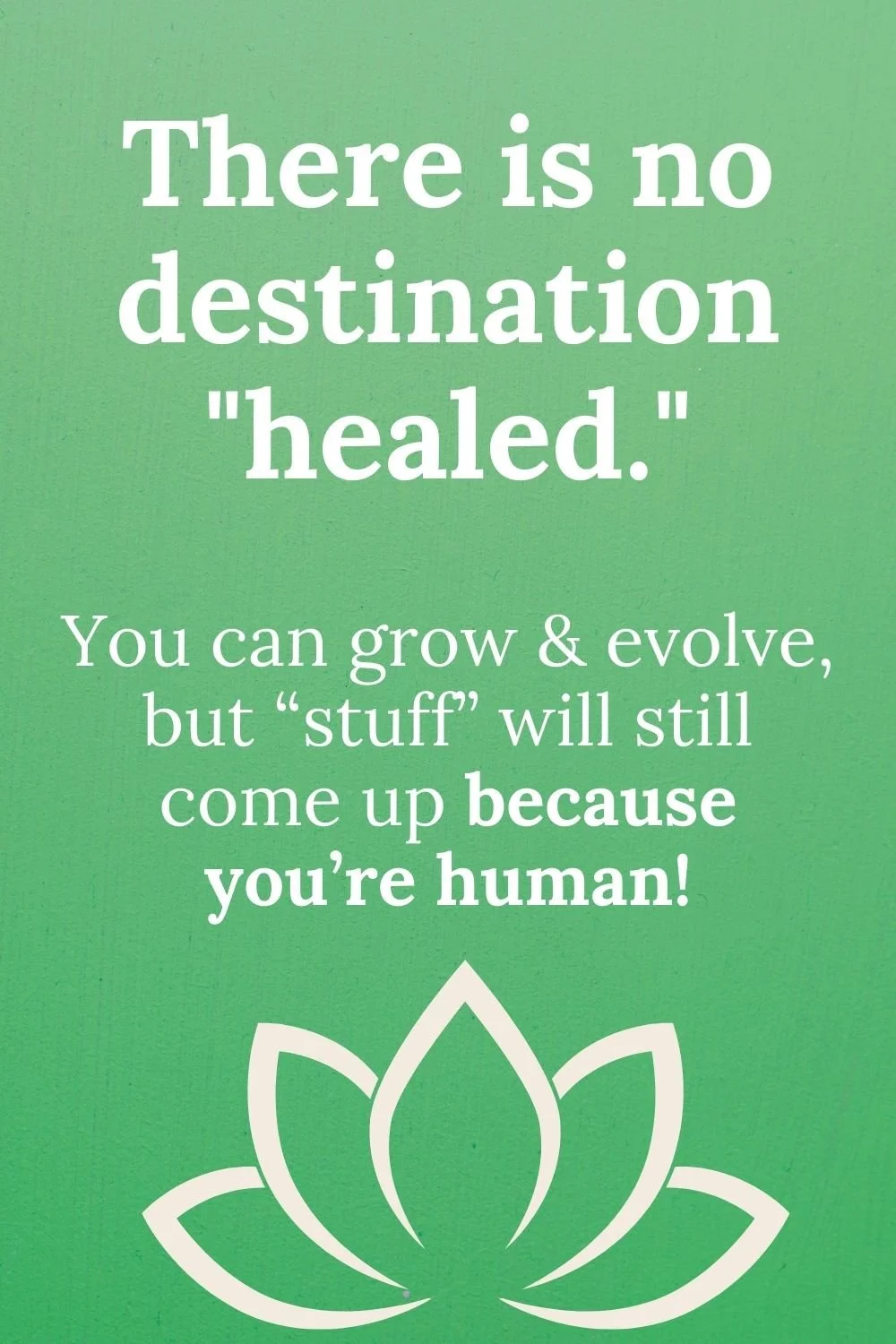
Allison's reaction was to be a little horrified. She thought, "Wait, Louise Hay, the queen of self-help, still has issues at 79? We're all doomed then." But upon further reflection, she realized this was actually a really helpful reframe. It shows that there is no destination called "healed." There's no destination called "full self-love."
You're always going to have some self-doubt. You're going to grow and you're going to evolve and you're going to be a better person and feel more confident and have more self-love. But there's always going to be stuff because that's just life. We're human. Life is a journey, not a destination. It legit is a journey.
Resisting that idea actually causes a lot of suffering. When you start to just embrace it (it is just a journey, just more grist for the mill, just another issue), and now you have this great tool to use on it, then the whole healing and personal growth process becomes a lot easier and more fun, honestly.
EFT as a Self-Help Tool
One of the things I love about EFT is that you can teach it to someone and they can use aspects of it on their own. It's not like for minor things they have to keep running back to a practitioner. At some point, there are some minor things (I always say a lot of it is work stuff) where you can use it yourself.
Like you're headed into a meeting and you're nervous because you have to give a presentation. Perfect time to head to the bathroom and do some tapping, saying it quietly in your head, not saying it out loud. Everyday instances like that, or like Allison was saying, in traffic.
You're stuck in traffic and you're late. Freaking out about being late isn't going to make you any less late, but tapping can make you feel more relaxed. And amazingly, when you move into that more relaxed state (probably because you have more blood flow to your frontal lobe), all of a sudden solutions come. A lot of times you'll suddenly see, "Oh, wait a minute, if I get off at this exit, I could maybe make it in."
That's where it's really helpful to have this tool in your back pocket.

Reticular Activating System: Rewiring What You See
Allison mentioned something really interesting about a part of our brain called the reticular activating system (RAS). This is the part of our brain responsible for pattern identification. If you're thinking about getting a new car and you're like, "Ah, I might get a Jeep," and then all of a sudden you see Jeeps everywhere, that's your RAS at work. You wonder, "Were all these Jeeps here before and I just didn't see them?" And the answer is yes. All those Jeeps were there, they didn't just materialize, but your brain was considering them unimportant, so it was straining them out. It wasn't focusing on that.
When you start doing tapping, not only are you getting blood to the frontal lobe and thinking more clearly, but you're able to start shifting your reticular activating system to see different patterns.
Changing Your Beliefs Changes What You Attract
Allison talks about this a lot with her clients who are dating again. Many of them will come to her and say, "Oh, there's no good men left out there. There's only jerks. I only date jerks." That's their reticular activating system at work, because there are good guys out there. There are jerks out there, 100 percent. But there are good guys out there too.
But if they believe at a deep level that there are only jerks, their reticular activating system is going to pick up on jerks around them: jerks in the store, jerks in traffic. And they'll think, "Oh, see?" That's the confirmation bias we all do, where we confirm what we already believed to be true.
When you start doing tapping, it works particularly well on beliefs. You start questioning those beliefs that you thought were facts. You're actually also retraining your reticular activating system. Suddenly you see the guy carrying the lady's groceries out of the grocery store and you think, "Oh, there are nice men out there." You suddenly start seeing them because you've essentially rewired your brain with the tapping.
We've talked about the reticular activating system before (I just call it RAS because that's easier to say). The whole point of why it's blocking out certain things is because we would be so overstimulated if we were actually conscious of everything that our body's taking in. It's blocking certain smells and sights and things that we don't really need to pay attention to because we're trying to drive a car and we need to be focused on the road and the cars around us, not the plane flying overhead or whatever.
From Divorce to Dating Like a Goddess
I wanted to shift gears and talk about Allison's book and what prompted her to write it.
Her story began with her own experience. She went through a divorce in her early forties. She doesn't think anybody ever gets married thinking they'll be single again. That's not the plan. So it's pretty jarring and disorienting.
Having to start dating again after 20 years, and having to start dating again at midlife when everything is different, was challenging. When you're in your twenties, pretty much everyone is single and it's really easy to meet people. People are interested in meeting new people. By the time you're in your forties or fifties, most people are coupled and most people are doing the same thing with the same group of people all the time. It's a really different experience.
Then there's technology. When Allison was in her twenties, there were barely cell phones. There was no online dating. That wasn't a thing. Now that is the thing. All of that change meant she had to get her feet under her again and figure it out.
The Journey to Writing the Book
She made a group of friends with a bunch of other single women, and that was really great. They all taught each other things about dating. But one of the things Allison realized was that even though she had all this training in psychology and working with individuals, she really didn't know much about couples psychology. So she did a deep dive on that.
Looking at the research, examining her own experience of her internal struggles, talking with her friends and her clients (and it's funny how life does this, but she started drawing in more single clients even before she wrote the book), she learned from everyone's experiences.
She wanted to understand what works in the dating world, what doesn't work, why some people repeat the pattern of dating the same person in a different body, and why people settle for breadcrumbs instead of really being able to stand in their power and attract a healthy partner.
She decided to pull all those insights together, and she knew she wanted to make it a book with tapping because she knew tapping worked. She basically teaches eight different mindset shifts in the book, and each chapter has a tapping script with it so that someone can get started on clearing those patterns.
She does think you need a practitioner to really dive into the deep stuff (she has a practitioner she works with herself) because a lot of this is childhood-related. But you can at least start to feel more confident with the tapping scripts in the book.
What Does It Mean to Date Like a Goddess?
That title came to Allison well before the book because she thought, "Wouldn't that be a great name for a book?" The whole point is that you're shifting your subconscious patterns to be able to stand in a really empowered, grounded place. When you get there, that's when you're able to connect with someone intimately at a really healthy level because you're not going to let your boundaries be violated and you're not going to settle for being treated less than you really desire. You're going to go after your desire.
The whole theory behind her book (and this is a theory some people don't like when they first find out because people just want to be told what to say or what to text back) is that it's not how it works. When you shift on the inside into this more high-vibe goddess kind of place, you magnetically attract in from the outside the right person for you. The more you do the work, the more and more you evolve.
The Journey to a Healthy Relationship
Allison was single for eight years before the relationship she's in now, which is a long-term relationship. She dated around during those years. And every guy was a little healthier and a little healthier and a little healthier. The guy she's with now is amazing and fantastic.
She doesn't think if she had met him at the beginning of those eight years that they would have been a match because her vibe, her subconscious patterns and programming, were not the best. They were not healthy. She had to do the work to get to the point where she could partner with a really healthy person.
Holistic Transformation Beyond Dating
I asked Allison how her work helps people with holistic transformation in other areas of their life beyond dating.
She thinks that's the coolest thing about EFT. You start to work on one area and everything gets better. It's just wild. Our brain has these neural connections that we don't even fully understand, but you'll start to see that if you're working on a fear of public speaking, your confidence around dating could grow, or your confidence around speaking up in your relationship, or whatever it is. When you start to work on one thing, there's this domino effect that happens with EFT tapping that really makes everything better.
She also thinks it's partially a function of spending more time in a regulated state, in that alpha brainwave state. The more time you spend there, the more regulated as a whole you become.
From Yelling Parent to Regulated Parent
Allison looks back sometimes with a lot of compassion for herself (she doesn't really have shame about it anymore because she tapped on it), but with a little bit of chagrin at the fact that she was a yeller with her kids when they were little. She yelled. She was a yelling parent.
She learned EFT tapping luckily when they were seven and nine. Pretty quickly into it, maybe a year into learning EFT, she suddenly realized, "Wow, I don't even yell. I don't lose my temper with them." They were still doing the same annoying things kids do, but she was different. She was regulated and things just didn't bother her at the same level.
That's the goal: that nice regulated, grounded, inner peace state that she truly believes tapping will bring you to.
Clearing Maladaptive Patterns to Manifest What You Desire
I asked if there was anything we didn't talk about that Allison thought was important for listeners to hear.
She wanted to go back to what she was saying about the work she does in clearing up patterns so that you can attract in the things you desire. It's not just about relationships. It's about anything: career, success, abundance, all these things.
We have so many maladaptive patterns that were put into us from childhood. EFT tapping is, to her, an unparalleled tool for clearing those up, and clearing them up very quickly. That is when everything on the outside starts to shift. It's when you start to ask, "What are these beliefs that I'm having? What do I think I deserve? What am I willing to accept? Am I willing to receive full love? Am I willing to receive full success and abundance?"
When you start asking those tough questions and tapping on those issues, that's when miracles really show up in your life.

Meet Our Guest: Allison Jayne
Allison Jayne is a seasoned psychotherapist, EFT practitioner, and best-selling author who specializes in helping midlife women break painful relationship patterns and attract emotionally available, devoted partners. After experiencing her own divorce, Allison became deeply committed to supporting single women in midlife, particularly those who feel stuck in confusing, on-again/off-again dynamics with men they can’t seem to walk away from.
She is the creator of The Quit Him System—a neuroscience-based process designed to help women stop obsessing over emotionally unavailable men, calm the nervous-system triggers that keep them hooked, and finally feel grounded, clear, and in control again. Allison’s approach blends psychological insight with EFT tapping, guided meditation, and visualization techniques to help women release subconscious blocks and open up to genuine emotional safety and healthy love.
Her best-selling book, “Find Love Again: Learn to Date Like a Goddess,” expands on this mission by guiding you to rebuild confidence, reconnect with your inner worth, and call in the relationship of your dreams.
Connect with Allison:

Meet Our Host: Jennifer Robin O’Keefe
Jennifer Robin is always searching for the next thing that might help: the book, the practice, the reframe you didn't know existed but turns out to be exactly what you needed.
Through conversations with experts, authors, and everyday humans, along with personal reflection, Jennifer focuses on bridging the gap between "woo" and practical, accessible self-support. Her work is rooted in the belief that wellness is not about fixing yourself, but about remembering your worth and finding what genuinely works for you.
She has spent decades exploring personal growth, energy healing, and mind-body wellness. She's trained in EFT Tapping and coaching, tools she often references in her conversations. She's not positioning herself as an expert who has it all figured out. She approaches her work with humility, curiosity, and deep respect for individual experience.
Jennifer is a lifelong learner who cherishes books and notebooks. She loves diving into research and sharing what she learns in a way that feels relatable, compassionate, and pressure-free. These conversations are an invitation: to ask your own questions, gather perspectives that resonate, and build a life that actually feels good to you.