
You're Not Too Sensitive: What Your Body Is Trying to Tell You
Listen to the full episode:
Episode 55: Show Notes & Transcript
Hi friends, I've been working on my self-care and self-improvement (or as I like to call it, "self-restoration") for decades. I knew I had childhood trauma to process.
I've done therapy, mindset work, affirmations, EFT tapping, journaling, sound healing, shadow work, and much, much more. I've tried woo-woo things, out-there things, and have kept an open mind. And many of those things helped chip away damage and bring me back to my true self. A lot has been healed and restored, and yet I'm still finding things that remain.
Things I notice in myself that I wish I understood better, and frankly would like to release or at least relax and diminish. I'm talking about things like hypervigilance, the intensity of my responses to things other people brush off, and inner anger or sadness that sometimes rises from seemingly nowhere.
Can You Relate to These Patterns?
Can you relate? Maybe for you it's not hypervigilance—maybe it's people-pleasing that you can't seem to stop, even though you KNOW you're doing it. Or maybe it's shutting down emotionally when conflict starts, even though you want to stay present. Or maybe it's that knot in your stomach that shows up in certain situations and you have no idea why.
If you notice things like this in yourself, or other patterns I didn't even mention, it does NOT mean you are broken. It does not mean you need FIXING. It might mean there are parts of you that are trying to get your attention. Trying to help you address some things that are long forgotten by the everyday parts of you, but are still alive and active in other parts of you.
The Gift of Sensitivity
I've always been expertly skilled at reading the energy of a room. And especially of being able to read the energy of a person. I naturally pick up on things that other people don't notice. Things like subtle body language, facial expressions, tone of voice, and I'm sure other unseen vibrations that a person's body and aura gives off that can't be seen with my eyes. I think if I was born in caveman times, I'd be a valuable member of the tribe—alerting people that a tiger was lurking nearby or an enemy tribesman who says he wants a treaty really has alternate motives.
And honestly? This skill HAS served me well in modern times too. I've walked away from opportunities because something felt off—and later found out there was some fishiness going on. I've picked up on when coworkers and friends were struggling before they said a word, which meant I could be there for them. And I've sensed danger in situations where everything looked fine on the surface. This isn't paranoia—it's pattern recognition. It's data my body collected and learned to read. The problem isn't the skill itself. The problem is when my nervous system can't turn OFF the high alert, even when I'm genuinely safe.
And here and now in TODAY'S world, sometimes, other people get irritated with this skill. And I do think it's a skill and a gift that my body gave me from the early traumatic experiences. But I've been told this gift is a problem. I've heard things like "You're too sensitive." "You're reading into things." "Just let it go." "Stop overreacting."
Affirmations & Mindset Work Aren't Enough
So I've tried. I've spent a lot of time thinking something was wrong with me. That I needed to overcome this sensitivity. I've done the mindset work. I've told myself, "It's not a big deal. Don't make this into something it's not." I've said affirmations like, "I'm calm and grounded. I'm in control. I'm safe."
But here's the thing—I still pick up on those shifts. I still feel tension in a room before anyone says a word. And when someone raises their voice or swears—even if it's not directed at me—my whole body goes on alert even though anyone else nearby isn't affected at all.
Or, like I noticed recently, I'm walking my puppies and they start pulling and getting tangled up in their leashes, and I say "sit" or "stay" but they keep at it... and then I hear myself yell "No!" sharply, loudly, strongly. And I think, "Where the heck did that intensity of anger come from?" They're just being puppies and still learning to control their impulses, and I KNOW that. I hate hearing yelling or yelling myself... so where DID that come from?
And I find myself thinking and journaling:
"What am I missing?
What haven't I healed yet?
Why am I still like this?"
Have you ever felt like that? Like no matter how much self-help work you do, or how many childhood memories you try to heal… things keep popping up in your face, trying to get your attention?
The Missing Piece: Nervous System Dysregulation
Well, very recently I started doing research on something completely different, and I stumbled onto information that reframed almost everything I've learned and tried myself in the self-help and energy wellness realms.
I knew from prior work that my sensitivity and ability to read energy and pick up subtle cues came from a childhood coping mechanism that developed naturally to keep me safe. But what I didn't understand is how this all ties into the nervous system, and how incredibly embedded the nervous system IS to a lot of the self-help issues and topics I've experienced myself and heard others talking about.
I learned that high sensitivity, like I have with my body, means my body is still actively on high alert. Parts of me are standing at attention, scanning my environment for threats that aren't actually HERE anymore. It's like I have an entire army of nerve cells (AKA neurons) working their butts off, working around the clock with the mission to keep me, the person that I am, safe. Beyond how most other people's nervous systems do this job. Mine are like a highly specialized SWAT team!
Now I understand why affirmations and mindset work weren't enough for me, and why they won't be enough for many other people. They don't go deep enough. I realized—I might be working on the wrong level of personal healing and restoration entirely.
And that realization sent me down a research rabbit hole that I want to introduce you to today, because if YOU are working on self-care or self-help for ANY reason, I believe you need to know this information. I wish someone had clued me in 30 years ago!
Understanding Your Body's Survival Mode
For those of us who've been in the personal development world for a while, we're really good at the mindset work. We know about limiting beliefs. We journal. We do shadow work. We say our affirmations. We know our triggers.
But what happens when you've done all that work and you're still stuck? When you still react in ways that don't make sense? When you can't change your habits or gut reactions?
That's what we're exploring today.
I started researching why I was having such a disproportionate reaction to my puppies not listening. And I kept coming across this phrase: nervous system dysregulation.
Discovering CPTSD: Complex Trauma
Until about a week ago, I'd never even heard the term CPTSD (complex post-traumatic stress disorder). It refers to trauma that happens over time, especially in childhood. And when I started reading about it and about nervous system dysregulation, suddenly so many pieces clicked into place.
All those years I'd been working on my thoughts, my beliefs, my patterns—and that work mattered. But I'd been missing this whole other layer: my body was still living in survival mode. I didn't know that some of our strongest reactions aren't actually about our thoughts or beliefs at all. They're about our bodies trying to protect us.
I started reading Peter Levine's work on trauma and the nervous system, and so far it has been extremely eye-opening. Here's what I'm learning, and why I think it matters for ANYONE who's felt stuck despite doing all the "right" self-help work.
Your Nervous System & Threat Detection
Your nervous system is essentially your body's threat detection system. It's constantly scanning your environment asking, "Am I safe?" And when it decides you're not safe—even unconsciously—it kicks into action before your thinking brain even knows what's happening.
You've probably heard of fight or flight. When your nervous system perceives a threat, it prepares your body to either fight back or run away. But there are actually a few more nervous system responses, and you might recognize yourself in some of these:
FIGHT might look like getting defensive or argumentative over small things. Maybe someone gives you gentle feedback and you immediately start explaining why they're wrong, or you find yourself picking fights with people you love.
FLIGHT is when you avoid certain situations or conversations entirely. You might procrastinate, change the subject, leave the room, or find yourself suddenly too busy to deal with something uncomfortable.
FREEZE is when you feel paralyzed or shut down. You know you should speak up in that meeting, but the words just won't come. You want to leave a bad situation but you literally can't make yourself move.
FAWN is when you automatically try to please people or appease them to stay safe. You hear yourself agreeing to things you don't want to do. You're over-apologizing. You're trying to manage someone else's emotions or fix their mood to keep the peace.
There's even a fifth reaction that's rarely talked about—flop. This is where the body essentially shuts down completely and goes limp. It's an extreme survival response that can happen when fighting, fleeing, or freezing aren't options.

When Your Body Can't Tell Past from Present
And all this happens in your nervous system in a micro-fraction of a second. It has to! If a car is racing toward you, you don't have time to think about it. Your body needs to move NOW.
But here's where it gets complicated. Our nervous systems don't always distinguish between a current, real threat and a past threat. They don't even necessarily distinguish between a life-threatening danger and something that just feels threatening. For example, for some people, public speaking can trigger this "life-threatening" type of danger alert, while others have no problem speaking in public.
For people who've experienced trauma—especially ongoing trauma, particularly in childhood—the nervous system can get stuck in high alert mode. It's like a smoke alarm that's become so sensitive it goes off when you light a tiny candle.
And this makes sense when I think about walking my puppies when they're just not listening. It's highly, highly likely that somewhere in my body, at a level I'm not consciously aware of, my nervous system is perceiving a threat. Maybe it's about loss of control. Maybe it's about feeling unheard. Maybe it's something I haven't even identified yet.
But my body responds as if I'm in danger. Stress hormones and chemicals flood my system. My heart rate increases. My muscles tense. And I yell without even thinking. I'm sure there are some frustrated parents out there who can relate to this.
My thinking brain—the part that knows "these are just puppies being puppies"? Oh, that part is 100% offline. Power disconnected. That part's been hijacked by a protective response SWAT team in my nervous system that's trying to keep me safe from a threat that isn't actually there.
And this is why the affirmations were only partially effective for me, and why I couldn't just "try harder."
Top-Down vs. Bottom-Up Processing for Healing
When we say affirmations, we're only talking to our conscious minds, working with just our thoughts and beliefs. And that's absolutely valuable work. Mindset work matters, but it has its place. It's often more effective, I'm learning, after some healing work has been done on the nervous system level, which is deeper.
But if my nervous system has already decided I'm in danger and kicked into a protective response, my conscious thoughts can't override that. It's like trying to talk yourself out of a panic attack. Your thinking brain is saying "I'm fine, I'm safe," but your body is screaming "DANGER." You can't think your way out of a nervous system response.
This is why some people can do years of therapy, read all the books, know exactly what their patterns are, understand their childhood wounds—and still find themselves reacting in the same ways. It's not because they're not trying hard enough. It's not because they haven't found the right affirmation yet. It's because trauma and chronic stress don't just live in our minds. They live in our bodies. In our nervous systems.
The mindset work addresses the top-down processing—your thoughts influencing your feelings and behaviors. But nervous system work is bottom-up—starting with the body's physical responses and working up from there. Both matter. Both are important. But if you're only working on one level, you're missing half the picture.
Signs Your Nervous System Might Need Attention
So how do you know if this might be relevant for you? Here are some signs—and I want you to really pause and notice if any of these feel familiar:
You might know exactly what you'd LIKE to do in a situation, but when the moment comes, you freeze or react completely differently than you intended to. Like, you planned to calmly set a boundary, but instead you either said nothing or you came out way too strong. Does this sound familiar?
You might notice physical symptoms that come with emotional triggers—your heart racing, your stomach feeling sick, tightness in your shoulders or jaw, or feeling suddenly exhausted for no apparent reason. Your body is reacting before your mind even catches up!
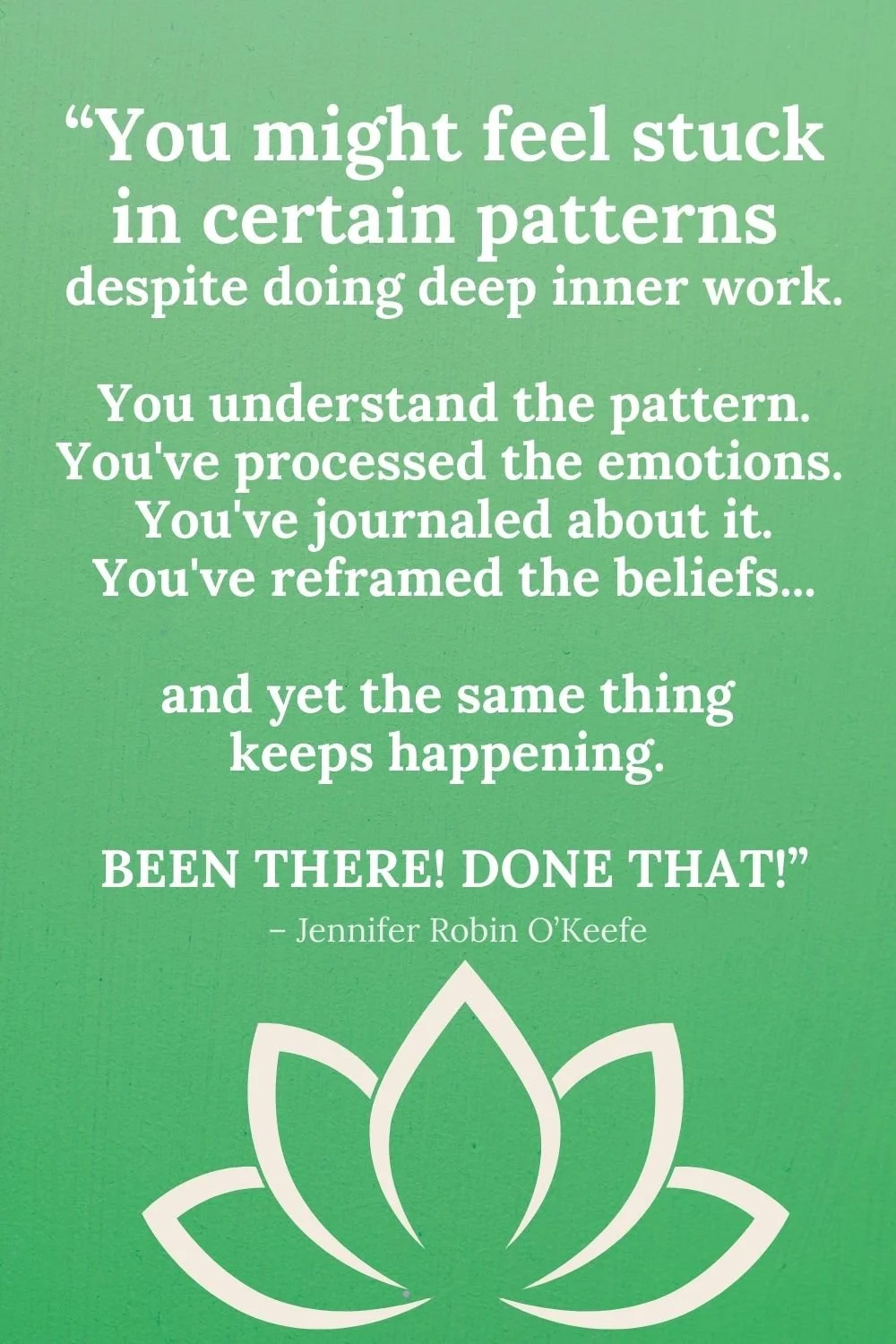
You might feel stuck in certain patterns despite doing deep inner work. You understand the pattern. You've processed the emotions. You've journaled about it. You've reframed the beliefs—and yet the same thing keeps happening. BEEN THERE! DONE THAT!
Or you might have reactions that feel way bigger than the current situation warrants—like yelling at puppies who are just being puppies, or feeling intense anxiety about something that logically you know is minor.
If any of this sounds familiar, it might be worth exploring whether your nervous system is carrying something your mind has already worked through.
Getting Started with Nervous System Healing
Now, I want to be really clear: I am a journalist, not a therapist or a doctor. I'm sharing what I'm learning as I learn it. If you're dealing with serious trauma, please work with a qualified professional. There are therapists who specialize in somatic work, in nervous system regulation, and in trauma. But here are some things I'm exploring that you might find helpful too:
Start noticing. When you have a big reaction to something, pay attention to the physical sensations in your body. Not the story about why you're upset—the actual sensations. Is your chest tight? Is your jaw clenched? Are your hands trembling? Do you feel hot or cold? You don't need to change anything yet. Just notice.
Practice pausing. Even just one breath between stimulus and response can make a difference. When you feel that activation starting, if you can catch it, take one deep breath. You're giving your thinking brain a chance to come back online.
Explore resources on nervous system regulation and trauma. I'm reading Peter Levine's work. You might also look into Polyvagal Theory by Stephen Porges, or Bessel van der Kolk's "The Body Keeps the Score." There are also somatic therapies like EMDR, Somatic Experiencing, and others that work directly with the nervous system.
And remember—grounding techniques aren't just woo-woo. There's actual science behind why they work. When you do things like feel your feet on the ground, notice five things you can see and hear, or splash cold water on your face, you're actually activating your vagus nerve. This is the nerve that runs from your brain down through your body, and it's like a hotline to your nervous system. These grounding practices send a direct signal to your body that says, "Hey, we're safe right now. You can stand down." It's not about positive thinking—it's about giving your body physical proof of safety.
Your Challenge: Building Body Awareness This Week
Okay, let's bring this all together. We've talked about what the nervous system is and how it works as your threat detection system. We've covered why mindset work and affirmations, while valuable, often aren't enough on their own if your body is still in survival mode. And we've looked at how to recognize if nervous system dysregulation might be at play in your life.
So here's my challenge for you this week:
Notice when you have a strong reaction to something. Maybe you freeze up in a meeting. Maybe you snap at someone you love. Maybe you feel sudden anxiety about something small.
Instead of immediately jumping to analyze why with your mind—why you feel this way, what belief is causing it, what you should think instead—pause and notice where you feel it in your body.
Just notice. No judgment. Can you name the sensation? Tight chest. Clenched jaw. Butterflies in your stomach. Heavy limbs.
We're just building awareness of the body's wisdom, of what it's trying to tell you.
Learning Together: An Invitation
I want you to know that I'm at the very beginning of this journey of nervous system exploration. I'm learning this in real time, right alongside you. This isn't something I've mastered—not even CLOSE! It's fresh, it's new, and it matters.
So much of wellness culture is about having all the answers. But sometimes the most helpful thing is just saying, "Hey, I noticed this thing. It might matter for you too."
So I'm inviting you to learn with me. This is just the introduction. We'll keep building on this in future episodes.
Have a fabulous week, my friends!

Meet Our Host: Jennifer Robin O’Keefe
Jennifer Robin is always searching for the next thing that might help: the book, the practice, the reframe you didn't know existed but turns out to be exactly what you needed.
Through conversations with experts, authors, and everyday humans, along with personal reflection, Jennifer focuses on bridging the gap between "woo" and practical, accessible self-support. Her work is rooted in the belief that wellness is not about fixing yourself, but about remembering your worth and finding what genuinely works for you.
She has spent decades exploring personal growth, energy healing, and mind-body wellness. She's trained in EFT Tapping and coaching, tools she often references in her conversations. She's not positioning herself as an expert who has it all figured out. She approaches her work with humility, curiosity, and deep respect for individual experience.
Jennifer is a lifelong learner who cherishes books and notebooks. She loves diving into research and sharing what she learns in a way that feels relatable, compassionate, and pressure-free. These conversations are an invitation: to ask your own questions, gather perspectives that resonate, and build a life that actually feels good to you.